
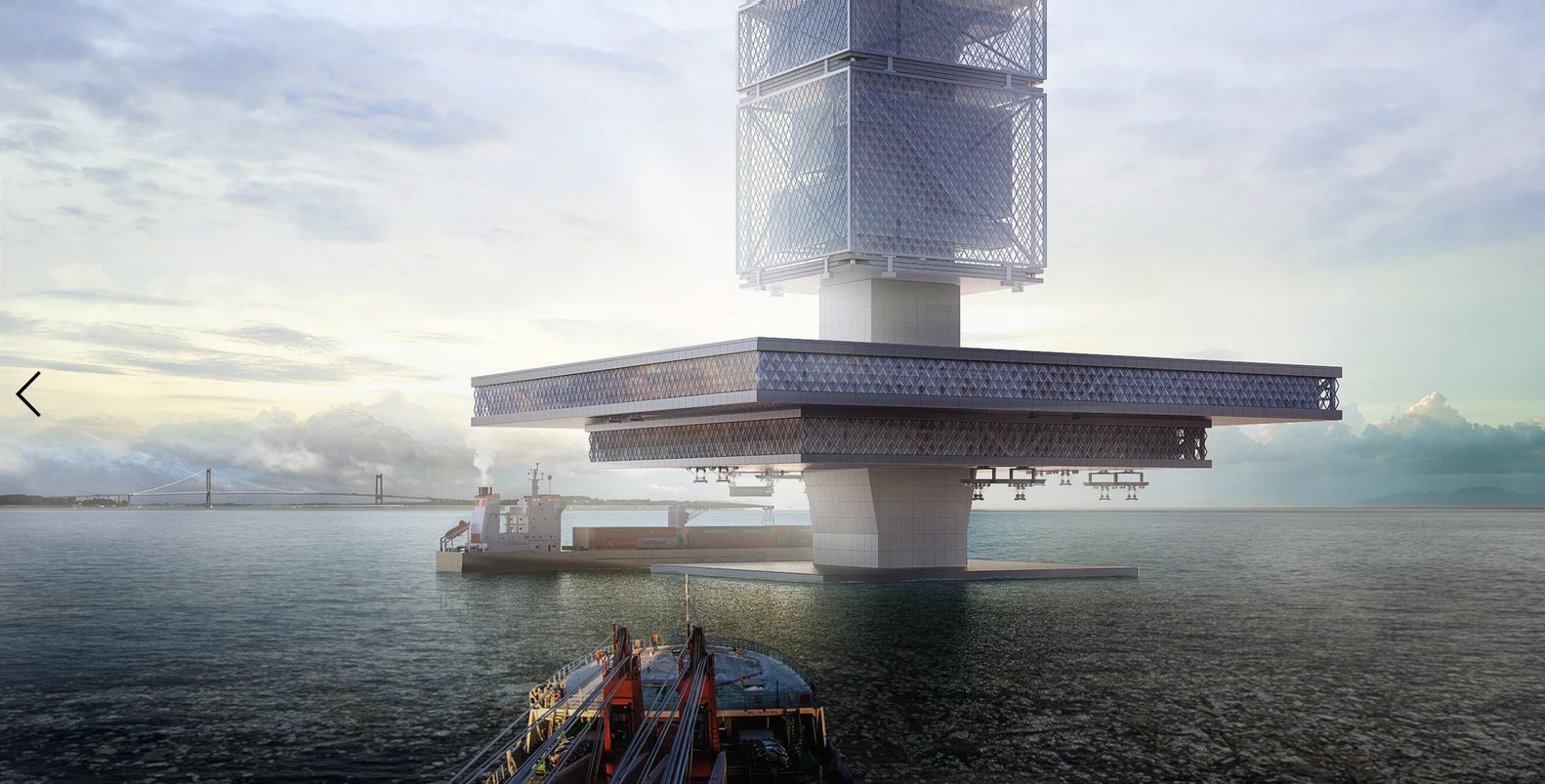
Architectural designer Honglin Li has designed an innovative waste management concept to tackle the Great Pacific Garbage Patch. The idea is called FILTRATION and has been awarded Honorable Mention in the 2019 eVolo Skyscraper Competition.
The imposing prefabricated mega-structure houses multiple MRF’s and Water Treatment Plants designed to recycle the floating plastic debris and clean seawater whilst combatting the world energy crisis.
The Great Pacific Garbage Patch is the largest accumulation of ocean plastic in the world and is located between Hawaii and California, also described as the Pacific trash vortex. The size of the patch is estimated to be three times the size of California with the layer of rubbish approximated to be 100ft thick on average. The patch is actually "two enormous masses of ever-growing garbage". What has been referred to as the "Eastern Garbage Patch" lies between Hawaii and California, while the "Western Garbage Patch" extends eastward from Japan to the Hawaiian Islands. An ocean current about 6,000 miles long, referred to as the Subtropical Convergence Zone, connects both of the patches, which extend over an indeterminate area of widely varying range, depending on the degree of plastic concentration used to define the affected area. The vortex is characterised by exceptionally high relative pelagic concentrations of plastic, chemical sludge, wood pulp, and other debris trapped by the currents of the North Pacific Gyre.
Some of the plastic in the patch has been found to be over 50 years old, and includes fragments of and items such as "plastic lighters, toothbrushes, water bottles, pens, baby bottles, cell phones, plastic bags, and nurdles". It is estimated that approximately "100 million tons of plastic are generated globally each year", and about 10% of that plastic ends up in the oceans. The United Nations Environmental Program recently estimated that "for every square mile of ocean", there are about "46,000 pieces of plastic". The small fibres of wood pulp found throughout the patch are "believed to originate from the thousands of tons of toilet paper flushed into the oceans daily". The patch is believed to have increased "10-fold each decade" since 1945.
FILTRATION not only houses MRF’s and Water Treatment Plants but the design also features a waste-to-energy plant. The design uses seawater to pump the debris and polluted water to the apex of the building, it then filters the water and recyclable materials down to the bottom. Non-recyclable material and recyclable material will then be transported away via tidal power. The main structure is comprised of a tree trunk core which allows for a flexible and inclusive range of facilities and plants to be attached on. Facilities ranging from plastic recycling facilities to waste-to-energy plants, all of which can be added on four sides at the foundations of the tower.
In his proposal Honglin states ‘This proposal provides a sustainable and even regenerative solution to floating waste, as well as a second chance to reconstruct the relationship between nature and human beings.’