
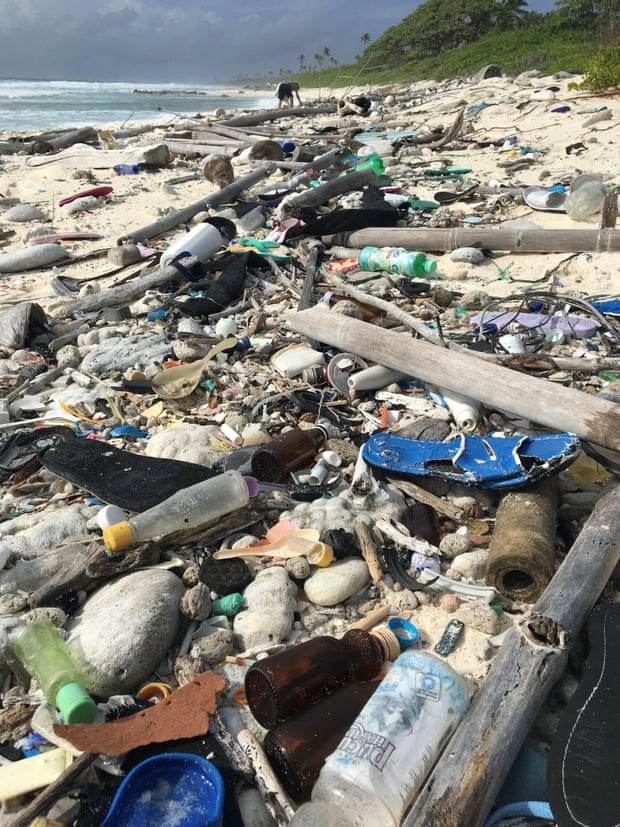
A study has revealed the shocking extent of plastic pollution in the Indian Ocean, a survey was carried out on a remote island group where a staggering amount of plastic debris regularly washes ashore.
Cocos (Keeling) Islands, a remote territory of Australia in the Indian Ocean has a population of 600. Its 2 coral atolls comprise 27 tiny islands with white-sand beaches, palm trees, lagoons and now, 414 million pieces of plastic. The debris mainly consists of bottles, cutlery, bags and straws, 977,000 shoes and 373,000 toothbrushes were also found by scientists. The 414 million pieces of plastic are estimated to weigh 238 tonnes.
The study published in the journal Nature, concluded the amount of debris on the island signifies an exponential increase of plastic pollution in the world’s oceans and highlights a worrying trend in the production and discharge of single-use products.
Jennifer Lavers the lead author of the study, from the University of Tasmania’s Institute of Marine and Antarctic Studies, stated that remote islands with small populations are the most effective case studies in order to gauge the volume of plastic debris in the oceans. Lavers said; “Islands such as these are like canaries in a coal mine and it’s increasingly urgent that we act on the warnings they are giving us. Plastic pollution is now ubiquitous in our oceans, and remote islands are an ideal place to get an objective view of the volume of plastic debris now circling the globe,”
The report said; “Our excessive and unrelenting demand for plastics, coupled with ineffective policy and waste management, has resulted in myriad negative effects on marine, freshwater, and terrestrial environments, including entanglement and ingestion of debris, and subsequent exposure to plastic-associated chemicals,”
“The Cocos (Keeling) Islands [are] touted as ‘Australia’s last unspoilt paradise’, with tourism a primary source of income for the local community. However, the impact of debris on tourism and [their] beaches is increasingly difficult to avoid. “Sadly, the situation on the Cocos (Keeling) Islands is not unique, with significant quantities of debris documented on islands and coastal areas from the Arctic to the Antarctic. Together, these islands and coastal areas reflect the acute symptoms of an otherwise rapidly increasing environmental hazard.”
“In the absence of rapid and meaningful change, anthropogenic debris will accumulate on beaches, with impacts increasingly felt by biodiversity and marine plastic mitigation will remain a perpetual game of catch-up,”
“Mitigation initiatives, including policy, should be mindful of the challenges faced by remote islands, and the communities that reside there.”
Annett Finger co-author of the report, from Victoria University said; “An estimated 12.7m tonnes of plastic entered our oceans in 2010 alone, with around 40% of plastics entering the waste stream in the same year they’re produced,”
“As a result of the growth in single-use consumer plastics, it’s estimated there are now 5.25 trillion pieces of ocean plastic debris.
“The scale of the problem means cleaning up our oceans is currently not possible, and cleaning beaches once they are polluted with plastic is time consuming, costly, and needs to be regularly repeated as thousands of new pieces of plastic wash up each day.”
The study can be found here- https://www.nature.com/articles/s41598-019-43375-4